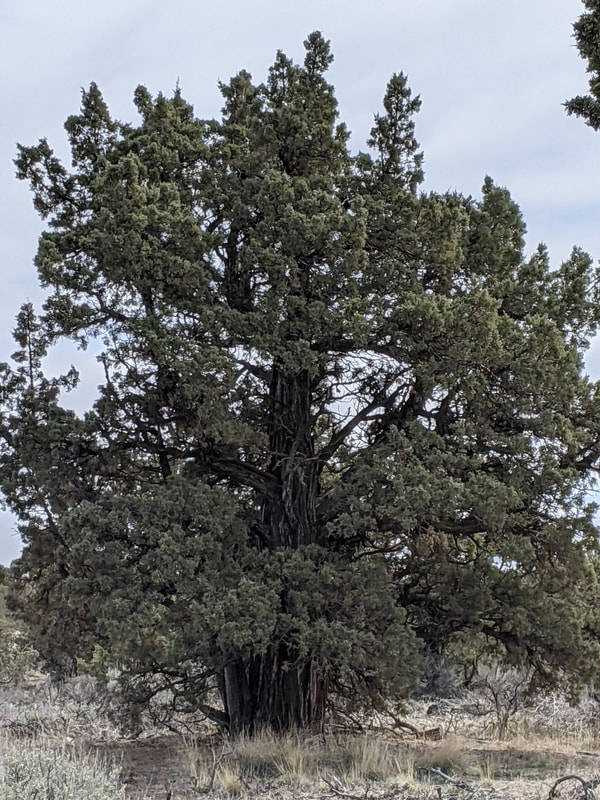
Central Oregon is home to a remarkable forest and shrubland ecosystem shaped in part by western juniper, Juniperus occidentalis. These native trees are more than scenery. They are habitat workhorses. Many old-growth junipers in our region are hundreds of years old, and some may be much older. As they mature, they produce berries that sustain countless birds through winter. Robins, waxwings, bluebirds, thrushes, finches, and many other species rely on these trees, especially during the harshest months of the year.
Central Oregon is home to a remarkable forest and shrubland ecosystem shaped in part by western juniper, Juniperus occidentalis. These native trees are more than scenery. They are habitat workhorses. Many old-growth junipers in our region are hundreds of years old, and some may be much older. As they mature, they produce berries that sustain countless birds through winter. Robins, waxwings, bluebirds, thrushes, finches, and many other species rely on these trees, especially during the harshest months of the year.
On our property, juniper, ponderosa pine, sagebrush, bitterbrush, rabbitbrush, native grasses, flowers, and forbs created a rich, layered habitat. This structure is the ecological backbone of much of Central and Eastern Oregon. Birds and mammals have adapted to these landscapes, even as humans have changed them through logging, grazing, farming, development, and the introduction of invasive plants.
Unfortunately, a growing and dangerous misunderstanding about fire and native plants is spreading. Across Central Oregon, people are cutting down juniper, sagebrush, and bitterbrush under the belief that these natives are the primary fire threat. In some cases, people are using goats to eliminate all native plants, even the fire-resistant grasses. And, sadly, what no one seems to want to talk about are the noxious weeds that permeate our landscapes.
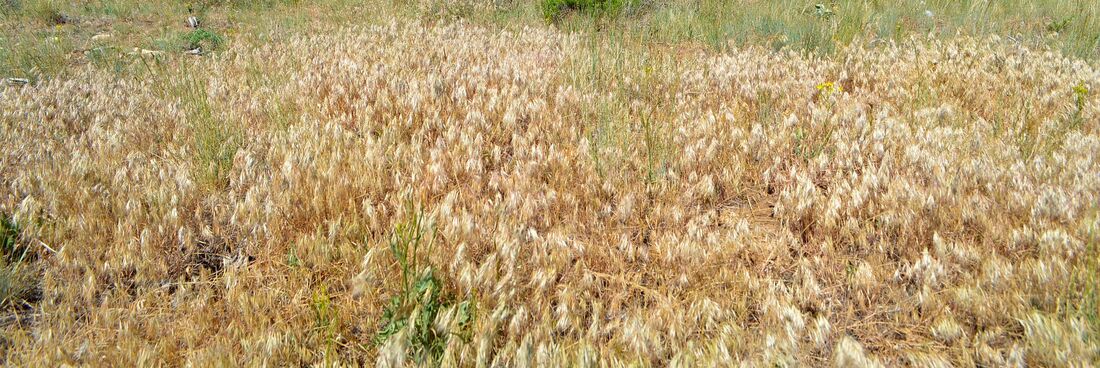
An endless carpet of invasive weeds and grasses in the Grandview Fire region is what drove the fire that burned through our area. The fire’s trajectory went directly over the 2021 fire. Instead of being restored, weeds were allowed to grow unchecked across that landscape, creating a carpet of tinder. The 2025 Flat Fire hit this area and became an inferno as it lit a continuous sea of dead, crispy weeds. It was not healthy native habitat that created this fire’s most dangerous behavior. It was weeds. In fact, our 40 acres of diverse native plants helped slow the fire. We had also created strategic firebreaks, open meadows, and habitat clumps rather than allowing a continuous carpet of tinderbox, dead vegetation. Those choices mattered.
Sadly, people are being allowed and even encouraged to completely denigrate their landscapes of any native plants to supposedly create a fire-resistant yard or landscape. Yet the lesson from the Flat Fire should be that we must manage land thoughtfully before and after fire, and that managing for weeds should be our top priority.
Yes, thinning can be appropriate. Yes, defensible space zones around homes and structures are essential. Yes, firebreaks matter. But wholesale removal of native plants is not restoration. It has the opposite effect: disturbed, open ground and more sunlight lead to pervasive weeds, which increase long-term fire risk. Studies show that removing juniper without addressing weeds results in more weeds.
Weeds are the enemy. Native plants are not.
After creating defensible space, hardening the home, and removing invasive weeds, land should be managed as an ecosystem, not treated like a war zone. Each property, meadow, woodland, and shrubland area should be evaluated for the species already present and for the wildlife that depends on them. Recovery should be selective, informed, and based on ecological principles.
Central Oregon’s birds and mammals now rely heavily on juniper woodland and native shrub communities. Many are cavity nesters or cavity users, including nuthatches, bluebirds, chickadees, woodpeckers, owls, and, in suitable areas, even wood ducks. Other birds, such as robins, finches, grosbeaks, crossbills, and many songbirds, use thicker canopy and shrub layers for nesting, shelter, and food.
These animals also need healthy sagebrush, bitterbrush, grasses, and flowering plants because those plants support insects. Insects feed birds, especially baby birds. It is vital to understand that the call to remove “brush” and “ladder fuels” for proposed fire treatment is actually also a call to remove habitat and forage for wildlife. In many cases, the “brush” to be removed are our native shrubs. Removing native understory plants removes far more than “brush.” It removes food, shelter, nesting sites, and the habitat’s living foundation.
A common argument against juniper is that they have taken over lands that were originally sagebrush steppe and grasslands. While this might have been true 150 years ago, that timeline also coincided with the introduction of sheep and other farming. It was a complex ecosystem-wide change that occurred across Central Oregon. Weeds, human structures, and roads were introduced. Notwithstanding the obvious ecological reality that ecosystems change (redwoods used to grow to Alaska), who are we to alter an entire ecosystem that has been in place for 150 years or more? (And how do we really know what that ecosystem was like then?)
Ecologically, going “back” to some presumed distant time before human colonization won’t be possible for many of the microecosystems that make up the centralized core of Central Oregon today. To the point, removing juniper for the elusive, unattainable goal of “restoring” sagebrush steppe across much of Central Oregon is frankly misguided. It also reeks of the perpetual vilification of one of our iconic native plants. Removing juniper across vast areas of Central Oregon simply won’t restore the full ecological diversity of sagebrush steppe. A patchwork of treeless, weed-infested landscapes won’t support any of the steppe’s species. When you remove juniper, more weeds appear; plants that relied on its shade and the moisture from its roots shrivel, and the soil dries out further.
It is absolutely valiant to attempt to save and restore sagebrush steppe. However, the places where that is possible are not in most people’s backyards or small acreages. You can’t create true sagebrush steppe, that specific ecosystem and the wealth of species ecologically associated with it, from a disconnected checkerboard of mostly weeds and grass, no matter how many junipers you remove. The landscape has to be robust enough to offer homes and food to those mammals and birds (and plants) which are the foundation of that particular ecosystem. True sagebrush steppe restoration requires large, connected areas of biologically diverse, intact habitat. Small isolated patches of sagebrush permeated by invasive grass will not support the full web of life that once thrived there. Sagebrush-dependent wildlife needs space, continuity, and plant diversity specific to that ecosystem.
We would love to see more of the sagebrush steppe restored across Eastern Oregon and the eastern edges of Central Oregon. But that will require more than cutting trees. It will require reducing invasive plants, rethinking grazing pressure, protecting native shrubs, and restoring the plant communities that birds and mammals actually need. The sagebrush steppe’s species are unique and irreplaceable: Brewer’s sparrows, sagebrush sparrows, sage thrashers, western meadowlarks, horned larks, vesper sparrows, green-tailed towhees, rock wrens, pygmy rabbits, pronghorn, sagebrush voles, and many others.
Drive east, and you can still find them.
Cutting down juniper without controlling invasives will open the canopy and give weeds more room to spread. Studies support this finding. In too many places, land managers are trading trees for weeds.
This is not restoration. It is a death sentence.
At the same time, the plants, animals, and insects that have evolved alongside our current native juniper forest have a right to be preserved. We should look for ways to improve this ecosystem, not destroy it. This ecosystem is not the source of our fires. These plants are not the enemy – they are our salvation. More natives = fewer inferno-producing weeds. And more moisture.
If we learned anything in our post-fire reality at Native Bird Care, it is that you can have both a fire-resistant landscape AND wildlife habitat. This is another article for another time, but our native plant ecosystem slowed the fire, dropped it to the ground, and let it slowly go out as it moved across the landscape. Healthy ecosystems can be fire-resistant. Juniper and sagebrush, sadly, though they slowed the fire, are not fire-adapted species. Juniper burns like a chimney, and sage and bitterbrush tend not to grow back after fire.
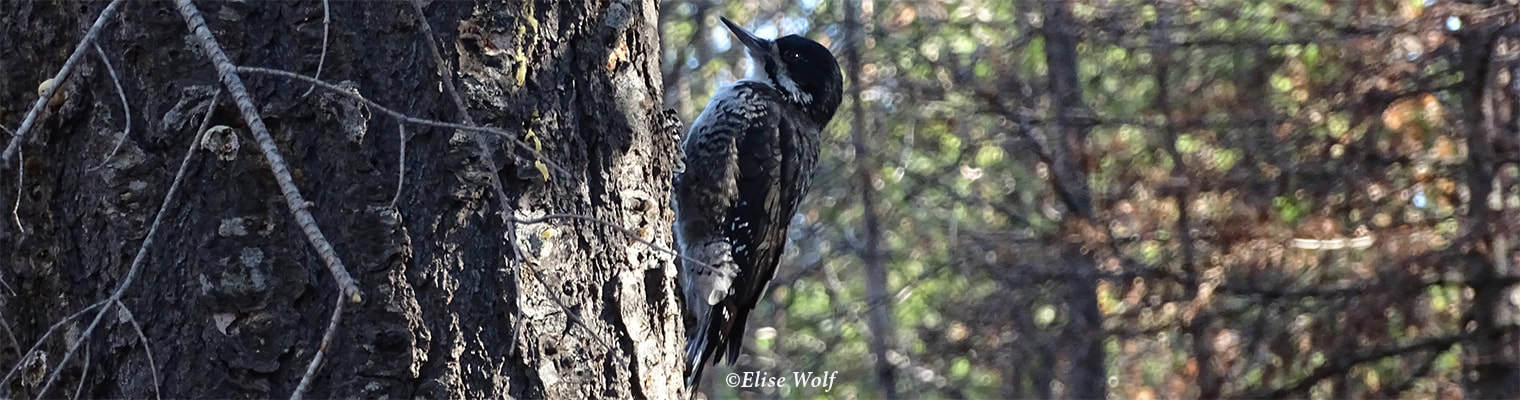
This last spring, wildflowers erupted across the landscape; huge swaths of fire-associated flowers blossomed, and grasses returned in full force. Burned forests invite all sorts of wildlife, birds and mammals, because they are an insect bonanza. We even had a black-backed woodpecker raise a family here this summer. Could we have removed more juniper and thinned the property more? Sure, but would it have still burned? According to the fire expert we hired to consult and treat our land, who was raised in Central Oregon, yes, the land still would have burned. Fire is fire.
Hardening our home helped the firefighters save it. Putting in firebreaks reduced the intensity. But fire is natural. This land will continue to heal. No logging or other activities that disturb the soils will allow the native plants to do their job and restore the land naturally. Shrubs will eventually come back. The dead ponderosa will offer white-headed woodpecker and small owl cavities until they fall in 2-4 years. The dead junipers will turn white and fossilize, but will remain wildlife homes. The land will continue to fill in with sage, bitter, and rabbitbrush. More flowers will come in.
For the sake of our wildlife, humans must stop confusing native habitat with fire hazard. A healthy native landscape is not the enemy. It is the foundation of recovery.
– Elise Wolf