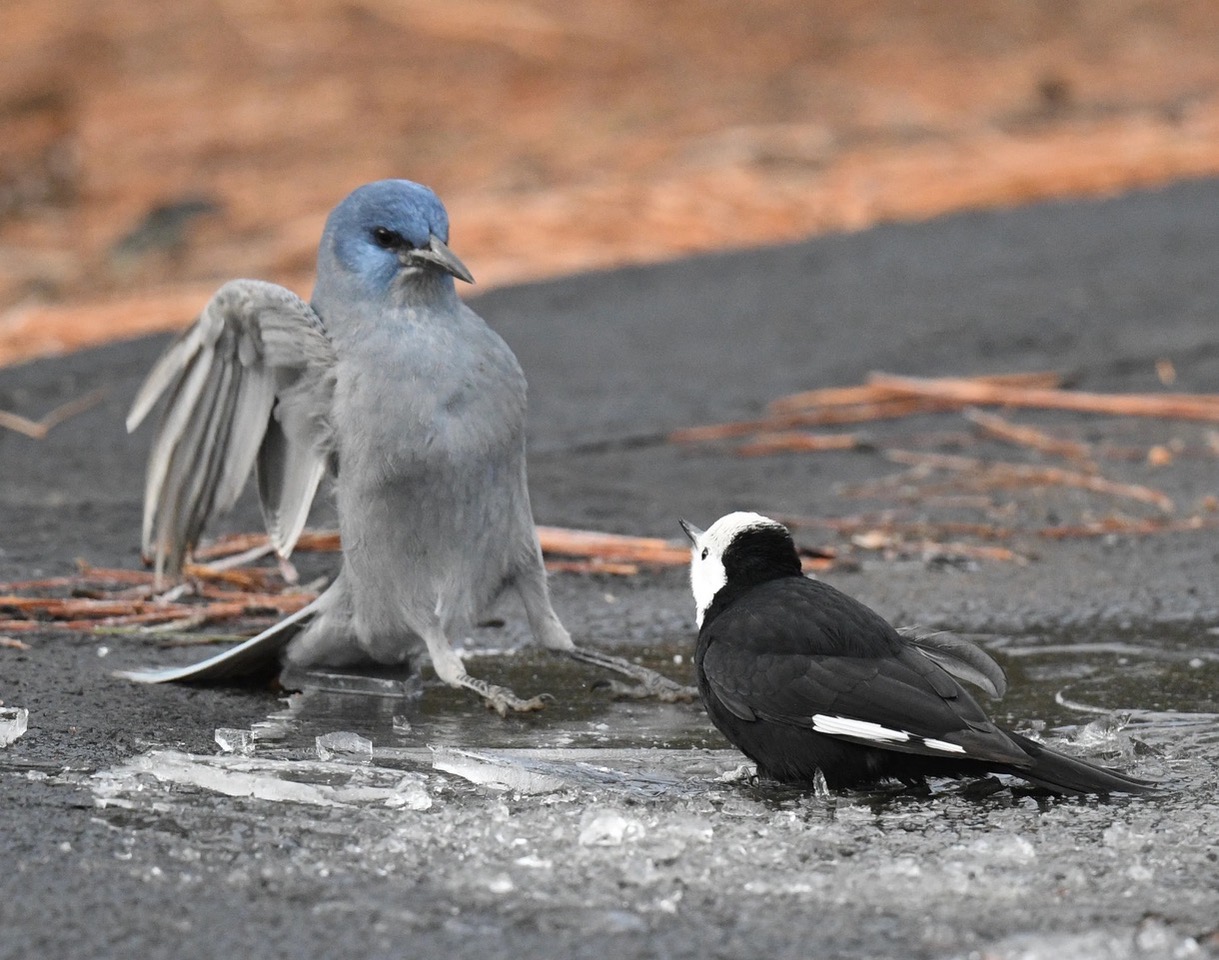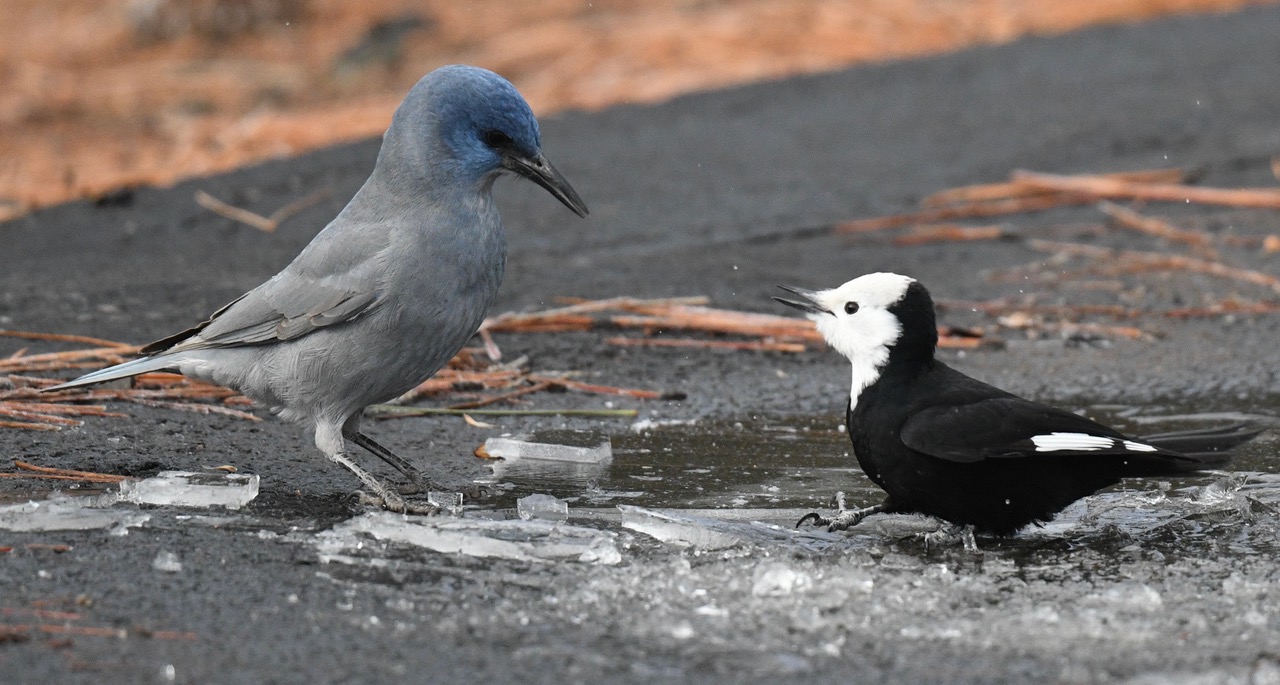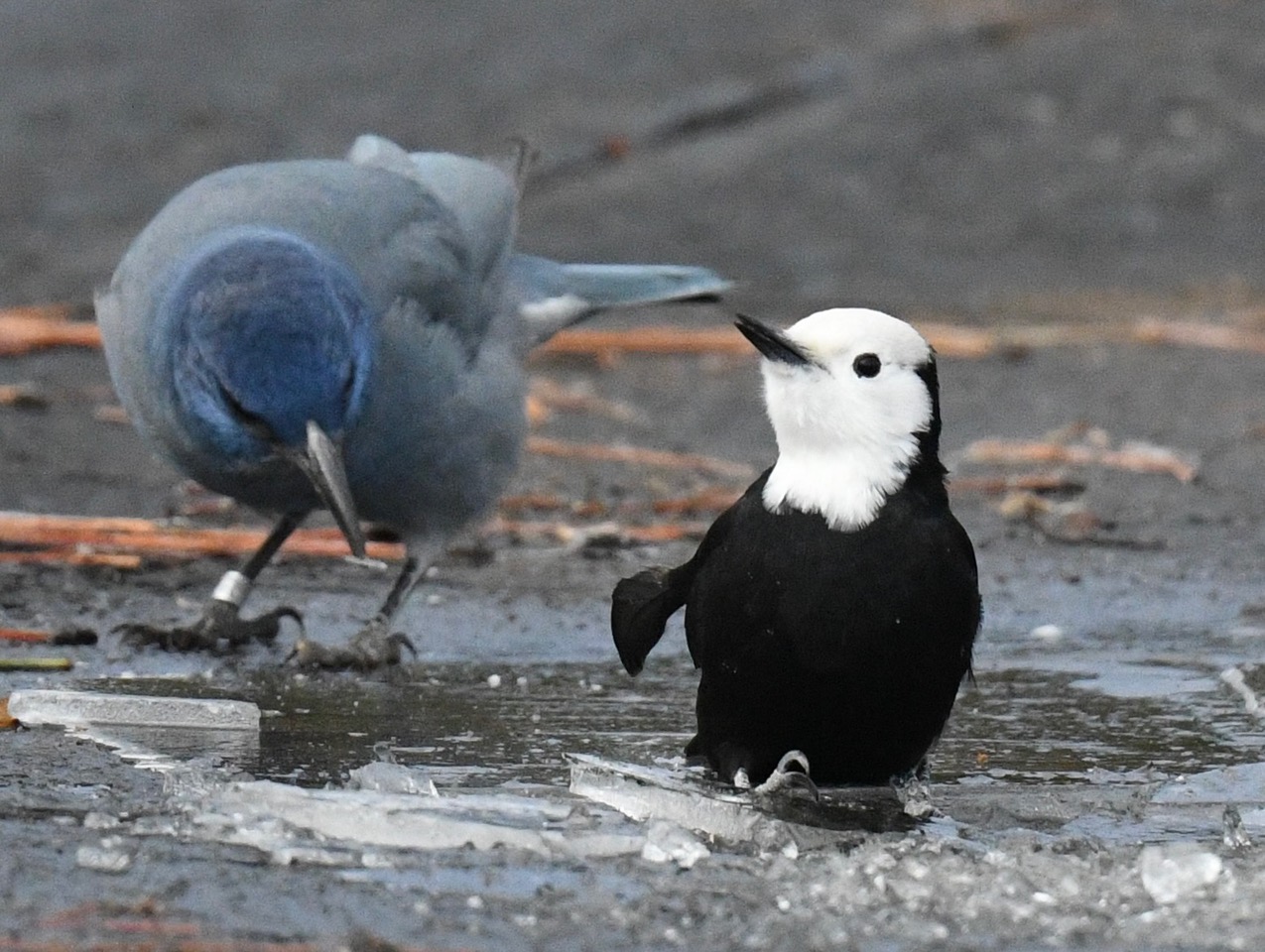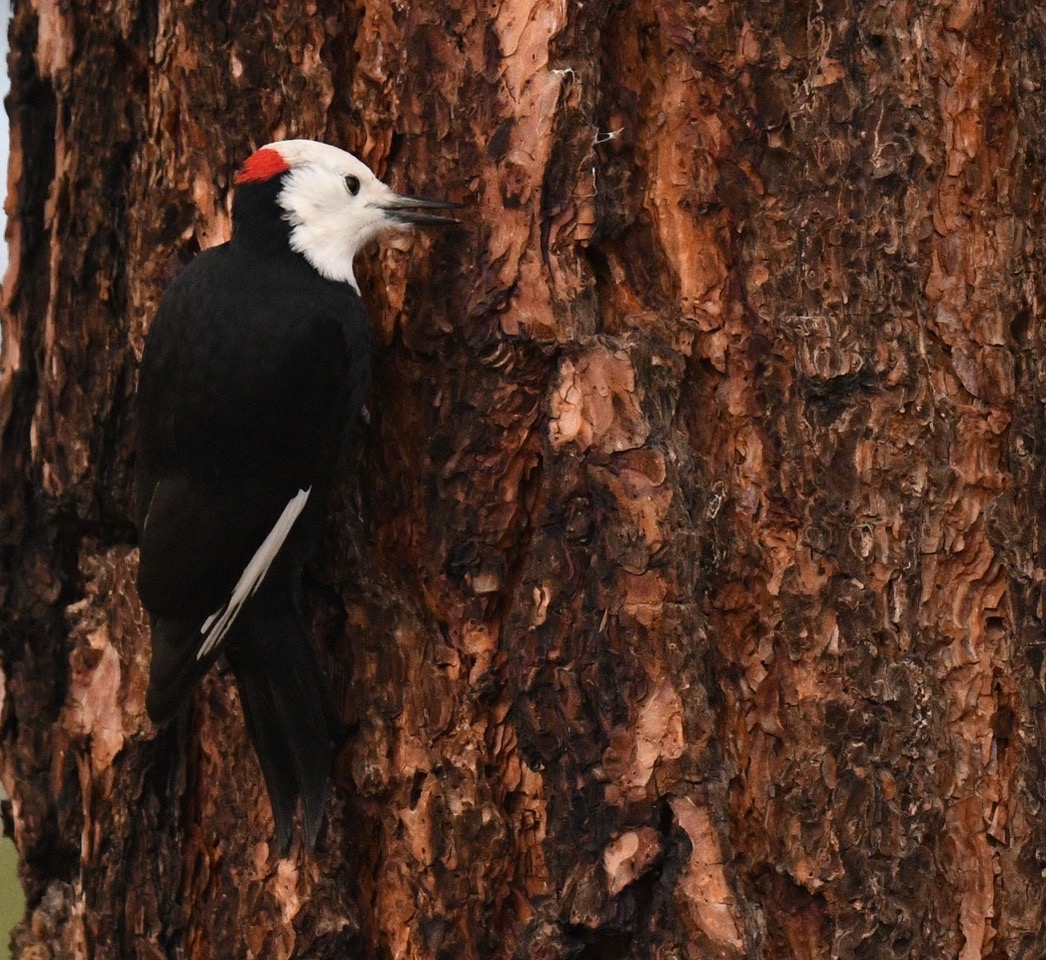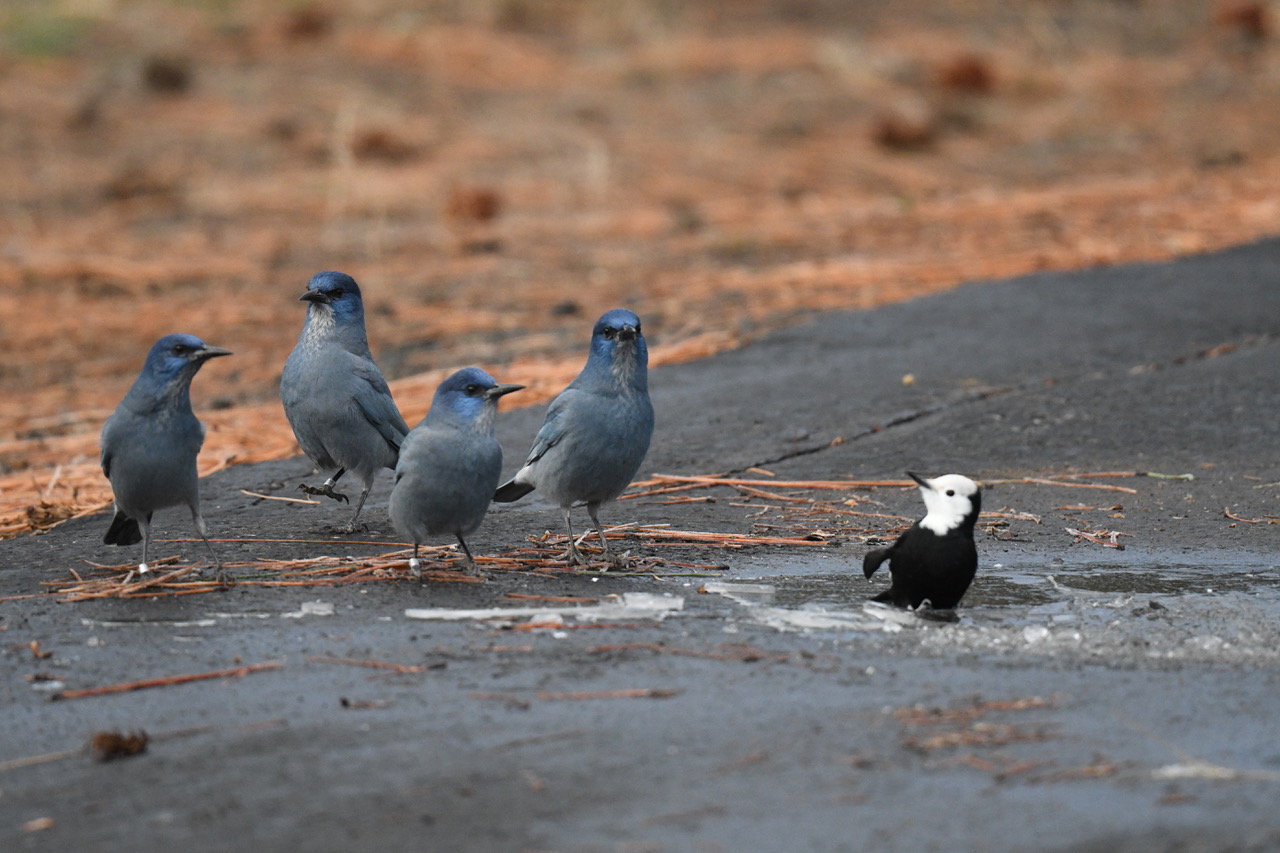
I was in the Sisters school parking lot taking photos for a student group that needed photos of White-headed Woodpeckers and Pinyon Jays for a presentation to the school board about a conservation-friendly ‘fuel reduction’ of the Trout Creek Conservation Area. I was lucky. Not only did two White-headed Woodpeckers turn up, but also a flock of Pinyon Jays and they were fighting over a puddle of water!
The story:
In early December 2025, a group of first-year Sisters High students was preparing for a presentation to the school board. They were advocating for a conservation-friendly fire risk reduction plan for the Trout Creek Conservation Area (TCCA). And, for the slideshow, they needed good photos of White-headed Woodpeckers and Pinyon Jays.
By way of background, the TCCA is a one-hundred and sixty-acre parcel owned by the Sisters School District and managed by the Deschutes Land Trust. https://www.deschuteslandtrust.org/visit/other-conserved-lands/trout-creek-conservation-area. In addition to being the home of a very rare wildflower, the Peck’s Penstemon, the TCCA provides valuable habitat for several Oregon Species of Concern including White-headed Woodpeckers and Pinyon Jays.
Driven in part by local residents’ understandable concerns about wildfire risks, the school district and the Land Trust are considering how to reduce the risk of a catastrophic wildfire in the TCCA. Hearing about this plan, a group of first-year biology students, who did some research in the TCCA, felt it was important to tell the school board and superintendent what they learned about fire ecology. Having gathered data from many models, including the https://www.nativebirdcare.org approach that was successfully tested in the Flat Fire, the students felt the most effective long-term defense against mega wildfires is conserving healthy ecosystems that are naturally resistant to catastrophic wildfire.
The students learned that native woodpeckers and jays are necessary for an intact ecosystem where, among other benefits, these birds consume a huge quantity of wood-boring beetles (and their larvae). These bugs, if not eaten, would weaken otherwise fire-resilient trees like Ponderosa Pines.
One student had a statistic from a Swiss study of Three-toed Woodpeckers stating each woodpecker ate around 670,000 bark beetles per year, making
them far more effective than beetle traps.
https://www.waldwissen.net/en/forestry/forest-protection/insects/bark-beetles-and-woodpecker
Our local Pinyon Jay flock is an incredible free pest control service where a hundred or more of them regularly move through the TCCA tossing leaf litter and downfall all about as they glean. In their wake, the smaller birds benefit from the upturned material to further naturally cleanse the forest.
So, as the birder-parent of one of the student presenters, I was tasked with providing photos of the TCCA’s Pinyon Jays and White-headed Woodpeckers. Having been given only a few days for my task, I threw my camera in the car for school drop-off and hoped for the birds to appear conveniently in my busy schedule.
Well, walking back to the car after dropping off the last kid at the high school, a flock of Pinyon Jays descended from the TCCA along with two White-headed Woodpeckers! They proceeded to fight over small white de-icer balls spread over the paths and puddles in the parking lot that had been broken up by parent cars. One of the woodpeckers and four or more Pinyon Jays swooped to the puddle near me. I think the de-icer pellets are salty and desirable to birds? And, so the battle for the puddle began! It was a special moment to watch that female woodpecker stand up to the Jays. She fended off four of them – two of Oregon’s Species of Concern together at one puddle! And I had my camera in hand!
Seemingly by attitude alone, the female woodpecker successfully warded off multiple Pinyon Jays for a good ten minutes. Finally, she flew off to join the male who was focused, I assume, on his job of pulling beetle larvae out of a Ponderosa Pine.
The students were delighted with the photographs and used them in their compelling, and hopefully successful, board presentation.
-

White-headed Woodpeckers and Pinyon Jays Photo by Sevilla Rhoads
-
White-headed Woodpeckers and Pinyon Jays Photo by Sevilla Rhoads
-
White-headed Woodpeckers and Pinyon Jays Photo by Sevilla Rhoads
-
White headed woodpecker, photo by Sevilla Rhoads
-
White-headed Woodpeckers and Pinyon Jays Photo by Sevilla Rhoads